I had actually written this post one year back on a visit to Mysore, but had neglected to post it. Travelling through India I got so caught up in experiencing everything there that sitting at home and writing became less exciting. Anyways, on year on I’m remembering this beautiful festival as I have returned for another visit to India.
***
I was excited to go to Mysore for Dasara (spelt Dussehra in some regions) since so many people had said the celebrations were particularly beautiful there. The whole experience ended up being way more than I had expected. I came in blind, just open to the experience without much prior research. Honestly, if someone had described to me exactly what the Dasara parade would entail, I don’t think I would have gone – but I’m so glad that I did.
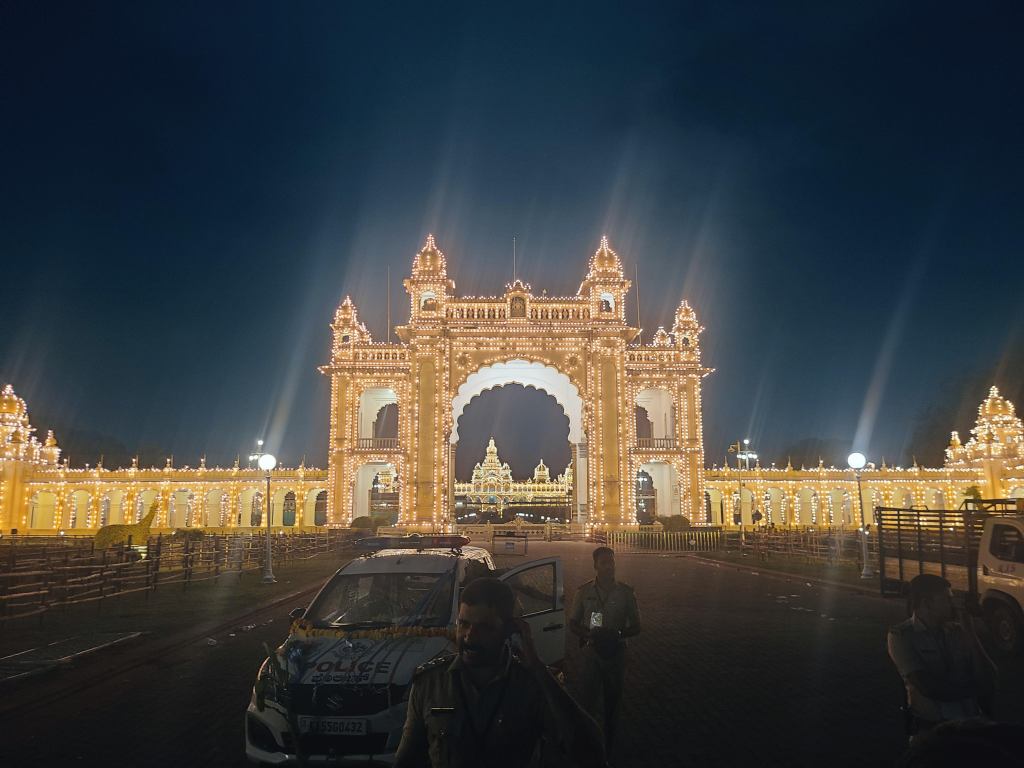
On the last night of Dasara I took a rickshaw to the palace to see the beautiful lights and enjoy a visual spectacle that was way more elaborate than any Christmas lights display I had ever seen growing up in Canada. I had heard it would be busy, but the crowds were much more than I expected. However I walked through the crowds and enjoyed, but, of course there had to be at least one little hiccup – while walking along the sidewalk I fell into a hole a good half-metre deep. Luckily, I was hoisted out within a millisecond by at least twenty concerned people (I almost felt bad seeing the utter shock on their face when they saw a naive white girl getting hurt!) So embarassed, I hobbled off to the side and disappeared into the crowd, telling myself that it was fine, it didn’t hurt at all. But as I continued walking I thought that okay, maybe it did hurt a little, and then a few minutes later I noticed that, okay, it is kind of bleeding a lot. The hole in the cobble had left a small gash in my leg that while not anywhere near life-threatening, was at the very least uncomfortable.
So I thought no problem, I’ll ask for a plaster at the hotel. But after another ten to twenty minutes more I realised that a little plaster wasn’t going to be enough, and I really could not wait that long. Luckily, I came across a little pharmacy stall a few hundred metres down the path, asking to buy a plaster and some iodine. He didn’t understand what I meant by iodine until I showed him my bleeding leg and he nodded to say “oh, got it.” I also requested a bottle of water to clean off the wound right then and there on the side of the road. I moved to pour the water on my leg but he pharmacist stopped me, horrified, passing me a bottle of hydrogen peroxide to use instead. I dabbed it on with a cotton but he was unsatisfied, and quickly instructed a man to shower my leg with H2O2 before I could bandage it up and keep going. Thanks to the kindness and quick-thinking of the pharmacist, the wound turned into a scar but not an infection.
The next morning, I was a little sore, but very excited for the day ahead. I got ready to go to the parade and asked at the front desk of my hotel for suggestions for watching the parade. They recommended going to a sister hotel to sit comfortably inside, order a drink, and watch from there. But did I do that? Of course not. When I finally got an autorickshaw close enough to where the parade would be, I just stepped out onto the street. I saw some chairs set up for comfortable viewing, but I couldn’t be bothered to figure out how to get there. Instead, I just plopped myself down on a nice-looking piece of concrete to watch with the other thousands of spectators who had come without paying for any extra comforts. Arriving at 11:30 for the parade meant to start around noon, little did I know that the parade still wouldn’t reach there for another three and a half hours. I had gotten a water bottle but no food, no mat to sit on, no umbrella, nothing – and not a food stall nor a washroom was in sight. The sun beat down hot on the unshaded ground, my arms getting tanned while I pulled my dupatta (shawl) further and further over my head in an attempt to stop the sun’s rays from reaching my face. After an hour or two of sitting there doing nothing, a kind group of girls invited me to share their mat with them. So I squished between them and an older auntie, taking turns stretching our legs without having too much uncomfortable overlap of our strained, hurting bodies. I slowly started chatting with them, first in Hindi, then in English (many people in Karnataka have better English than Hindi anyway), as they curiously asked me about my life and I about theirs.
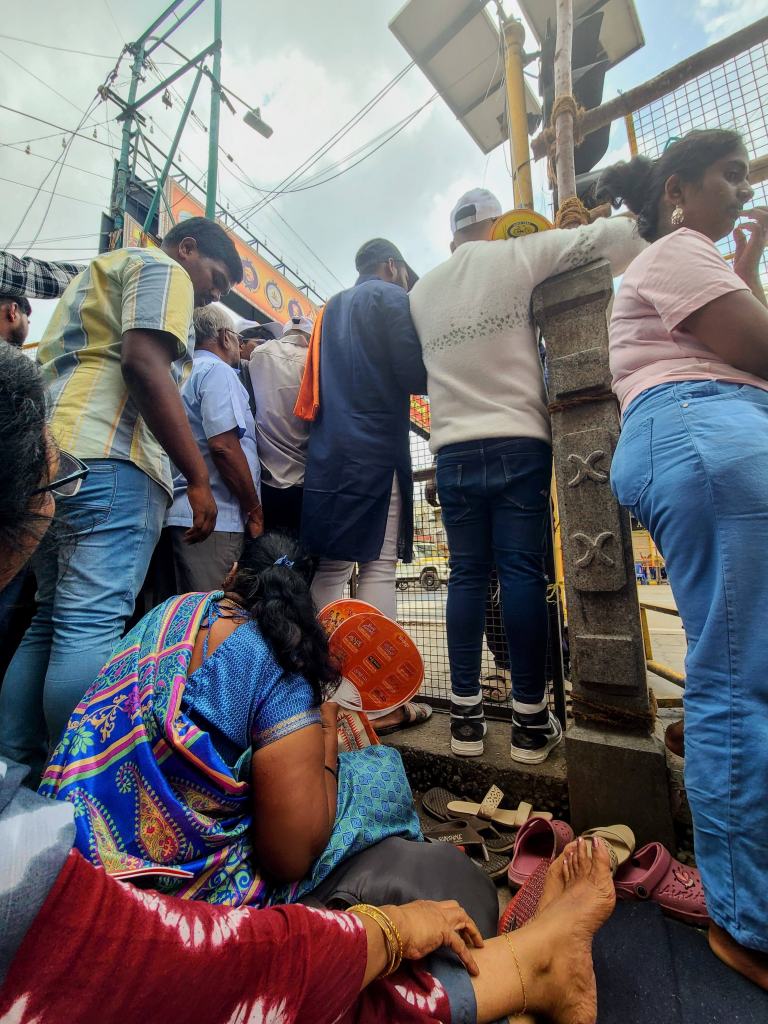
After some time we inevitably got hungry, and luckily some of the others had the forethought to prepare for the need for sustenance. An aunty offered me a dish from her huge container of rice, piling it onto a silver cardboard plate and I ate it with my hands as I waited in the sun. Later, once the parade had started, the organisers also provided some snacks. But unlike what I’m used to, where generally there are some prewrapped packaged foods, they were passing out long pieces of peeled and sliced cucumber, no packaging needed, that were passed from hand to hand to make sure everyone got a taste. After sitting and waiting for hours in the sun, the clouds finally brought relief, but it wasn’t longing before it started to rain. A few drops – fine, we ignored it. But soon it started pouring so heavily that we all stood up and one of the girls pulled me in closer to shelter under their shared umbrella.
Finally, the parade started, and the whole crowd slammed against the grate, the rain continuing to pour. They had kindly lent their umbrella, but unfortunately the edge of another was at just the right place that all the rain rolled of the edge to pour directly onto my shoulder. Meanwhile, the ground was going from one to two to three centimetres deep in water, the bloody scratch on my foot from the night before being bathed in the same flood that lifted empty bottles and food scraps from the ground. But despite the discomfort, everyone (myself included) was still full of excitement for this annual event that brings thousands to the city each year. The organisers also had to bear on the rain, and the other spectators laughed as they saw a man hold a chair above his head as an umbrella, and we thus christened him “chair uncle.”
The crowds here were more than anything I had ever seen in my life; so crowded it seemed like a complete chaos. But in reality it wasn’t – despite everyone being squished against the grates, there was a sense of organisation and courtesy amongst the crowd. Without anyone having to direct us, we somehow organised to have the shortest children and women in front, followed by the medium than tall women, and then men at the back so everyone would be able to see.
The parade consisted of generally, a series of floats all meant to represent a different district in the state of Karnataka. Each float had a little assortment of things, sometimes a little bit incongruous. From images of important figures, to popular crops, to a papier mâché reenactment of a historical battle to a modern set of wind turbines, and sometimes a combination of all of these sorts of things on the same float.
And then between each float were groups of performers: drummers, dancers, people costumed as gods. This exuberant display went on for over 3 hours, and I can hardly imagine how exhausted the performers must have been; yet, they displayed the most intense energy. They all just seemed so excited to be doing what they were doing. Perhaps, apart from the sheer scale and grandeur, it was this intense energy that made it feel so different from other parades. Yes, generally the performers are happy, but this was something else – the performers really relished in the joy of the holiday.
Most people outside of India don’t even know what Karnataka is, but here you could see each and every one of the 31 districts represented in brilliant diversity. Everyone expressed pride in their district, one of the spectators describing to me the Kannada texts that I couldn’t understand. The boys behind us chanted their own chorus, at some points yelling “biscuit” over and over again so much that I was starting to debate whether biscuit meant something other than a cookie in Kannada. But yes, that was it, they were heartily cheering for cookies, and only after a couple of hours, their wish was satisfied when a pack of biscuits was thrown over the gate, with just enough biscuits for everyone to get perhaps half a cookie to munch on.
However, the loudest cries though were in celebration of Abhimanyu. Someone explained to me about the god Abhimanyu who was being carried in the procession. Afterwards, though, I realised that I had misunderstood and they weren’t cheering for a god. Abhimanyu was not the idol being carried, but the elephant who was carrying him! The elephants are an integral part of the parade, and after 50 years they are set to retire and enjoy the rest of their lives in relaxation. At 49, this was Abhimanyu’s last year, and he was so beloved that these throngs of young boys and men never cheered for anything louder.
This parade was like something I have never seen before. Of course I have seen many parades: Santa Day Parade, Calgary Stampede Parade, whatever. But somehow, this felt different. Some people had travelled all the way from Bangalore that day, a full 3 hours journey early in the morning just for the parade. The crowd was so excited to enjoy their holiday and celebrate the diverse cultures of their own province. While I’m not sure if I’d choose to repeat spending over six hours on the bare concrete in the sun and the rain, I definitely will not forget this incredibly impressive parade.
 as birds forsake their nests
Leave a comment